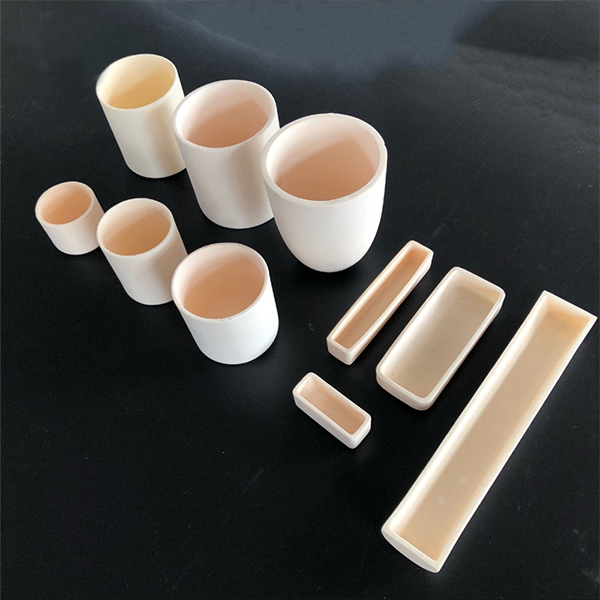
The measured data shows that the influence of alumina ceramic crucible wall thickness on high-temperature melting exhibits obvious bidirectional differentiation characteristics. Thin walled and thick walled crucibles have their own advantages and disadvantages, and their adaptation scenarios are completely different.
Thin-wall alumina ceramic crucibles with wall thickness ranging from 2 mm to 3 mm feature core advantages centered on thermal response performance. Boasting low thermal resistance and rapid heat transfer across the wall, these crucibles can quickly match the furnace’s heating and cooling rates, drastically cutting heating time for high-temperature melting. They are ideal for high-efficiency experimental scenarios such as rapid sintering and short-duration smelting of microscale samples.Additionally, the lighter self-weight of thin-wall crucibles enables precise tracking of temperature fluctuations. It effectively reduces excess heat buildup during high-temperature holding phases and improves the accuracy of experimental temperature control.
However, thin-walled crucibles also have prominent drawbacks, posing potential hazards in high-frequency high-temperature experiments. Their thin-walled structure results in insufficient mechanical strength, making them unable to withstand the static pressure of large-volume molten materials and alternating electromagnetic stress generated during melting. They are strictly prohibited for high-temperature melting operations involving large material loads and prolonged heat preservation.
Thick-walled alumina ceramic crucibles with a wall thickness of ≥3 mm deliver outstanding advantages in high-temperature structural stability. The reinforced ceramic wall drastically enhances resistance to thermal and mechanical shock, effectively counteracting thermal expansion and contraction stresses at high temperatures to prevent microcrack formation. They are suitable for industrial smelting and routine high-temperature experiments featuring frequent thermal cycles, prolonged heating durations and large temperature differentials.Furthermore, the thick-wall structure reliably blocks melt penetration and inhibits corrosion of the crucible inner surface by high-temperature molten materials, eliminating sample contamination. This makes the crucibles ideal for applications requiring ultra-high purity, such as high-purity metal smelting and semiconductor material fabrication.
Excessively thick crucible walls significantly increase thermal resistance and slow down heat conduction. After the furnace heats up, the temperature inside the crucible lags behind drastically. This not only greatly extends the overall melting cycle but also raises furnace energy consumption and experimental costs.